Lipedema or lymphedema? Clinical signs that distinguish two swollen legs
A review of the mechanism organizes the two diseases in the order in which fluid, fat and fibrosis appear — and this order is what physical examination detects: spared foot, absence of pitting, response to elevation, symmetry and pain. No biomarker, no closed image: the diagnosis is clinical.
 View the video lesson
Lymphedema affects between 140 and 250 million people worldwide; lipedema, according to the estimate adopted by the review, up to 6 to 11% of women. The two arrive at the vascular surgeon as "swollen leg", and the wrong labeled patient receives the wrong treatment. The review by Duhon et al., written by physiologists and biomedical engineers, organizes the two diseases by a simple axis: the order in which fluid, fat and fibrosis appear.
Five signs on physical examination
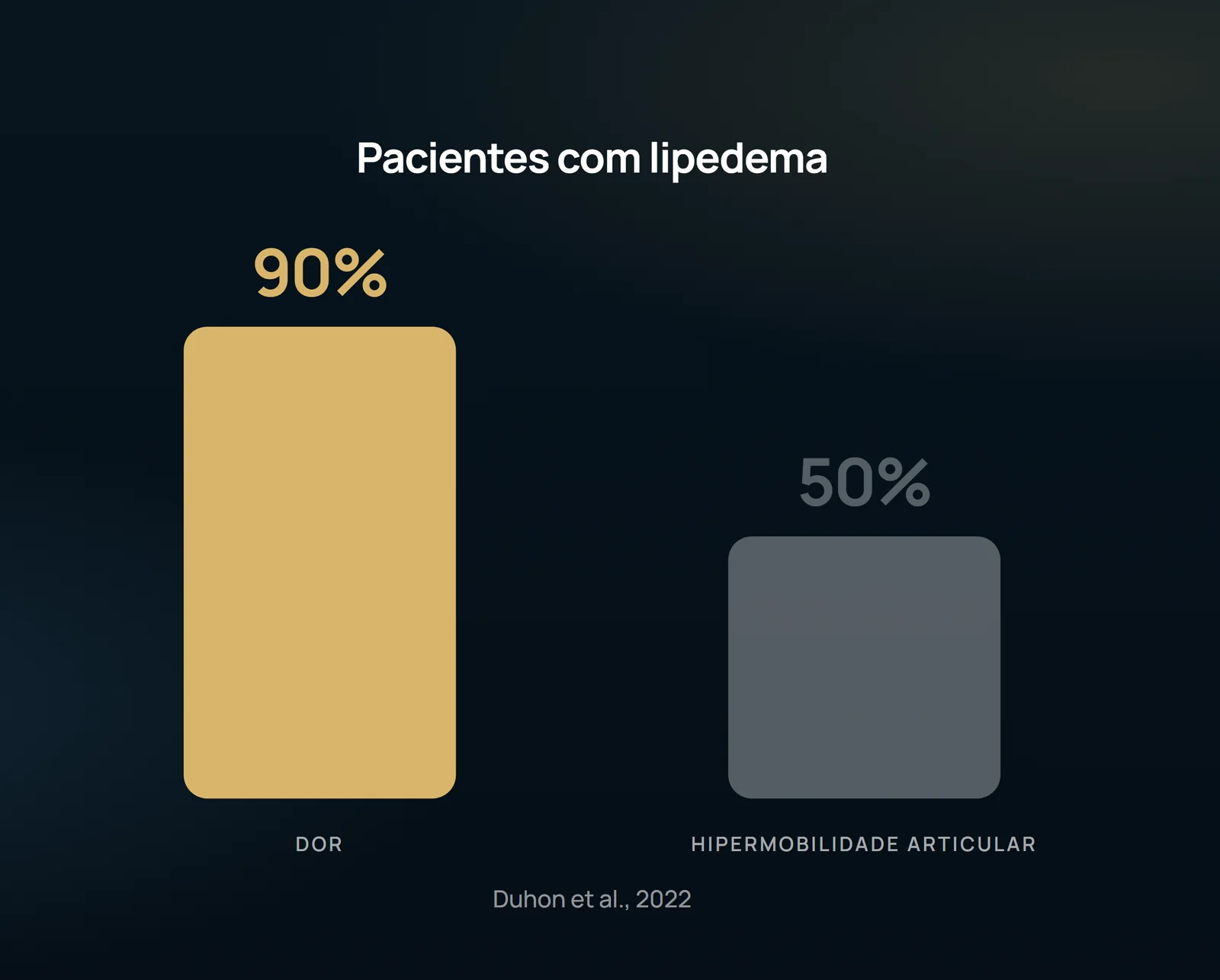
The foot: the lipedema saves hands and feet; in lymphedema the foot participates and Stemmer's signal is usually positive — but the review records that it is not pathognomonic. The pitting and elevation: in stage 1 lymphedema edema makes pitting and improves with high leg; in lipedema there is a fibrotic turgor, without pitting, which persists despite elevation. Symmetry: lipedema is bilateral and symmetrical; lymphedema can be unilateral, especially secondary to lymph node dissection or radiotherapy. Pain: present in up to 90% of patients with lipedema, regardless of BMI, accompanied by easy hematomas due to capillary fragility. The distribution: weight-resistant gynoid fat, with persistent edema and palpable subcutaneous nodules, against obesity android, responsive to diet, without edema and without pain.
The order: fluid, fat and fibrosis
In lymphedema, the fluid comes first, fat deposits later and fibrosis appears in stage 2. In lipedema, fibrosis is already present in stage 1 and the fluid component appears later. This is why the exam differs: early pitting in lymphedema, early firm turgor in lipedema. The review adds that lipedema also has impaired lymphatic transport, with increased VEGF-C without architecture change, in addition to microangiopathy and capillary fragility — and that both diseases can coexist. In the cell, lymphedema is conducted by CD4 T lymphocytes and Th2 response; lipedema, by macrophages in crown structures without the same involvement of T cells. The authors admit that the pathophysiology of lipedema is significantly less understood than that of lymphedema.

Genetics: what the test does and what it does not do
About a third of the primary lymphedema has known mutation. For lipedema, the review cites 21 deletion variants in 12 genes and a genomic association study with 130 patients without established causal gene. The practical recommendation is that the genetic test, in lipedema, serves only to exclude other conditions.
What the review does not allow to state
It does not authorize to indicate supplement: nattokinase, selenium and diosmin appear with the phrase "some efficacy, but require more study". It does not authorize to say that the order fluid-fat-fibrosis is proven: the figure shows the inversion with a dashed arrow, and traced arrow is hypothesis. It does not authorize prognosis: the text speaks of lack of treatment options when the diagnosis fails. It is a narrative review, without systematic search method; the prevalence of 6 to 11% was estimated from women treated by lymphedema who had lipedema; 90% of pain comes from a single reference; much of the mechanism comes from an animal model; and funding includes the Lipedema Foundation, declared paperless in writing. None of this changes what is worth: the diagnosis is trained physical examination and well-harvest history, without biomarker or closed image. Compromise yes, guarantee never.
Content addressed exclusively to health professionals. No individual result is guaranteed: the indication depends on clinical evaluation and imaging examination of each patient (CFM 2,336/2023).