The study that tried to replace phlebectomy — and showed the opposite
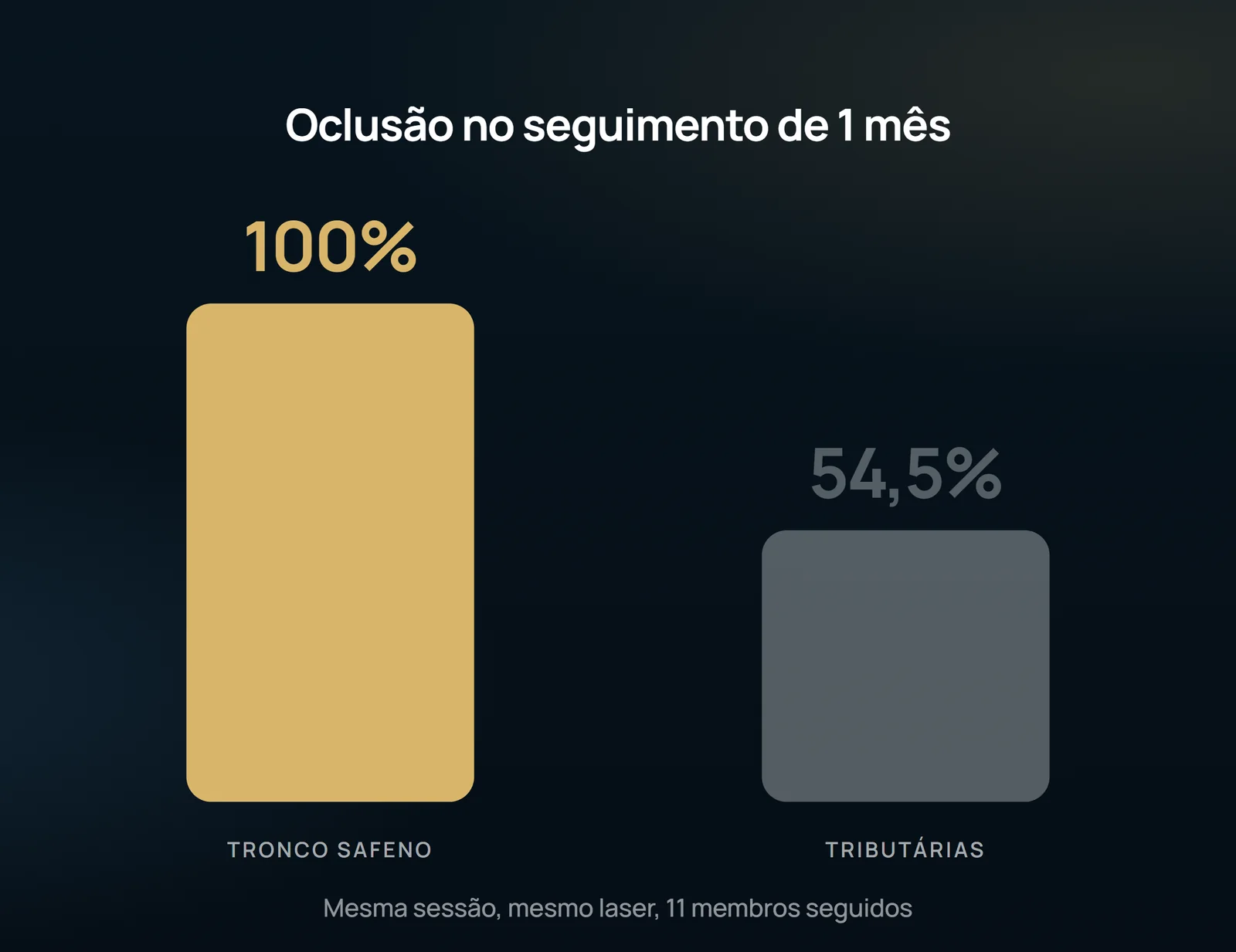
A Korean group punctured branch varicosities and treated them with a fiber of 400 μm in the same session of the tromcular endolaser. The trunk closed in 100% of the limbs; the tributaries, in 54.5%. The authors concluded against the very hypothesis — and that is the lesson.
 View the video lesson
The limitation is known by those who perform intravenous ablation: the treatment of the incompetent saphenous trunk does not directly treat branch varicosities, which usually requires outpatient phlebectomy or sclerotherapy of follow-up, about 4 to 6 weeks later. Park and collaborators tried to eliminate that second half.
Design and technique
A prospective, single-center study, from July to August 2005: 17 of the 22 patients evaluated were included, totaling 21 limbs (18 saphenous magnas and 3 parvas), male proportion: female 7:10, mean age 50.1 years (24 to 62), CEAP C2 to C4. The reflux was defined as a flow reversal for more than 0.5 seconds.
The trunk was treated conventionally: 600 μm fiber, 980 nm diode, tumescence with 100 to 250 mL of 0.05% lidocaine, 10 to 12 W in the magna and 8 to 10 W in the parva, in continuous mode, with an average removal of approximately 5 mm per second. Then, the tributaries marked with the patient standing were punctured with Jelco 18 G and treated with fiber of 400 μm — thinner on purpose, to prevent burn and facilitate advancement —, with 50 to 150 mL of tumescence and 4 to 6 W. Immediate high, compression medium class II (30 to 40 mmHg) for at least 1 month, analgesic and antibiotic for 3 days.
Two barriers
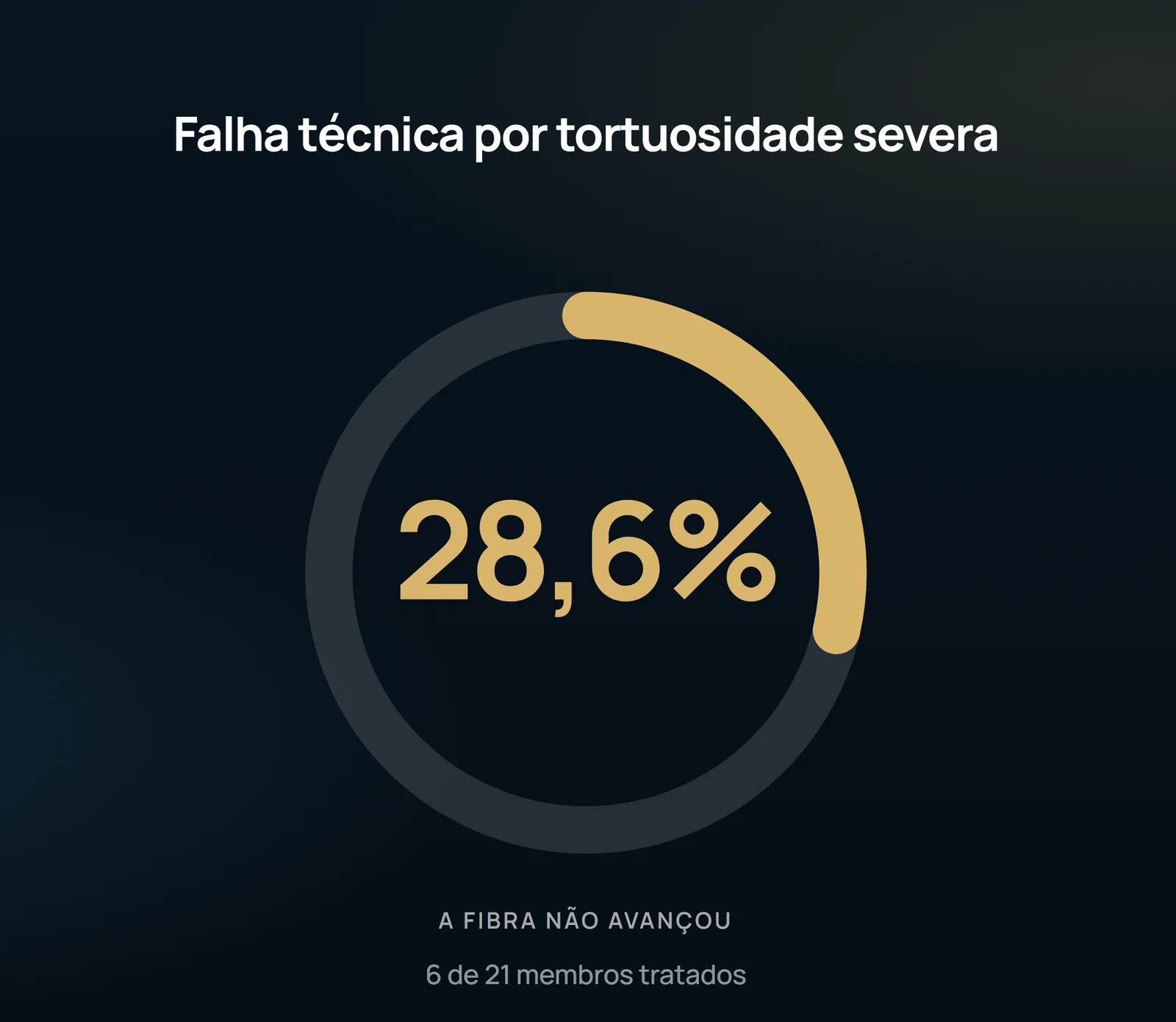
The first one was mechanical. In 6 of the 21 limbs (28.6%), severe tortuosity prevented fiber advancement to the desired segments; in 4 of these 6 limbs percutaneous sclerotherapy was performed at a 1-month follow-up. The ablation was technically possible in 15 of 21 limbs (71.4%).
The second barrier was biological. The continued closure of the treated saphenous was observed in 11 of 11 limbs (100%) in 1 month, in 4 limbs at 3 months and in 2 limbs at 6 months. tributaries, on the other hand, dispensed additional treatment in only 6 out of 11 limbs (54.5%) in 1 month; in the other 5 limbs (45.5%) the tributaries remained partially or totally patent and sclerotherapy was performed later at the outpatient clinic.
The cost of complications
Following 1 week, hematoma in 9 out of 15 limbs (60%) and stiffness or pain on sites treated in 5 out of 15 (33.3%) — both resolved completely in all 11 available limbs in 1 month. Paresthesia in 1 of 11 limbs (9%), mild and resolved in 1 month. Skin burns in 1 limb (9%), at the site of direct treatment of varicosities of the posterior calf, treated surgically and completely improved at 6 months. No deep vein thrombosis or pulmonary embolism.

Against what pattern
The authors record the pattern they were trying to overcome. In a randomized clinical trial comparing phlebectomy and sclerotherapy in lateral accessory varices, the risk of recurrence was significantly lower with outpatient phlebectomy: 2.1% versus 37.5%. Sadick and Wasser reported a success rate greater than 90% in 2 years of follow-up of 30 patients treated with diode laser combined with outpatient phlebectomy. Kahle and Leng reported occlusion of 76.8% in primary varices from 3 to 6 mm after sclerotherapy. Against these numbers, 54.5% in one month do not compete.
The physiopathological hypothesis of the authors themselves for failure is the most useful of the article: the 980 nm diode requires hemoglobin within the vein for ablation, and branch varicosities are smaller and more superficial than saphenous ones, with little blood. The choice of wavelength may have been inappropriate for the target.
What this study does not allow to affirm
The series is small and follow-up is short: 21 treated limbs, follow-up results obtained in 11, only 4 at 3 months and 2 at 6 months. There is no control group, there is no randomization and there is no sample calculation — comparisons with phlebectomy and sclerotherapy are indirect, made against the aforementioned literature, and not measured in the same study. The absence of deep venous thrombosis is not safety proof with this sample size. The result also does not condemn the concept of thermal ablation of tributaries in general: condemns this implementation, with 980 nm diode and 400 μm fiber, in this design. And it is worth a reading record: the summary of the article brings "11 of 15 limbs (71.4%)" to technical success, while the Results section brings "15 of 21 limbs (71.4%)"—it is the second that closes arithmetically, and this text uses.
Content addressed exclusively to health professionals. No individual result is guaranteed: the indication depends on clinical evaluation and imaging examination of each patient (CFM 2,336/2023).