Anatomical failure is not clinical recurrence — and laser illustrates the difference
The meta-analysis in a network of 74 randomized trials published in the BJS found more anatomical failure with EVLA than with open surgery in the long term — and, at the same time, no difference in clinical recurrence, reintervention or quality of life. The distance between the two outcomes is the finding that matters.
 View the video lesson
Two true things on the same five-year return: the treated saphenous disease appears partially recanalized in the duplex, and the patient reports being well. The network meta-analysis by Siribumrungong et al., published in the BJS, offers the statistical framework for this scene — and it is uncomfortable for those who treat anatomical failure as synonymous with failure.
What was gathered
Seventy-four randomized trials met the inclusion criteria, corresponding to 48 original trials after joining publications from the same cohort. Forty-nine trials compared intravenous ablation with open surgery. The follow-up ranged from 0.5 month to 8 years, and 18 of the 48 studies (38%) reported long-term outcomes, defined as more than 3 years. The compared interventions were open surgery, EVLA, RFA, ultrasound-guided sclerotherapy, cyanoacrylate and mechanochemical ablation, in addition to combinations with high ligation.
The primary outcome is an image finding
Anatomical failure was defined as incomplete or non-occlusion of the great saphenous vein, with or without reflux. It is important to fix this before reading any number: it is a finding of duplex, not symptom. Up to the medium term, EVLA and open surgery did not differ. In the long run, yes.
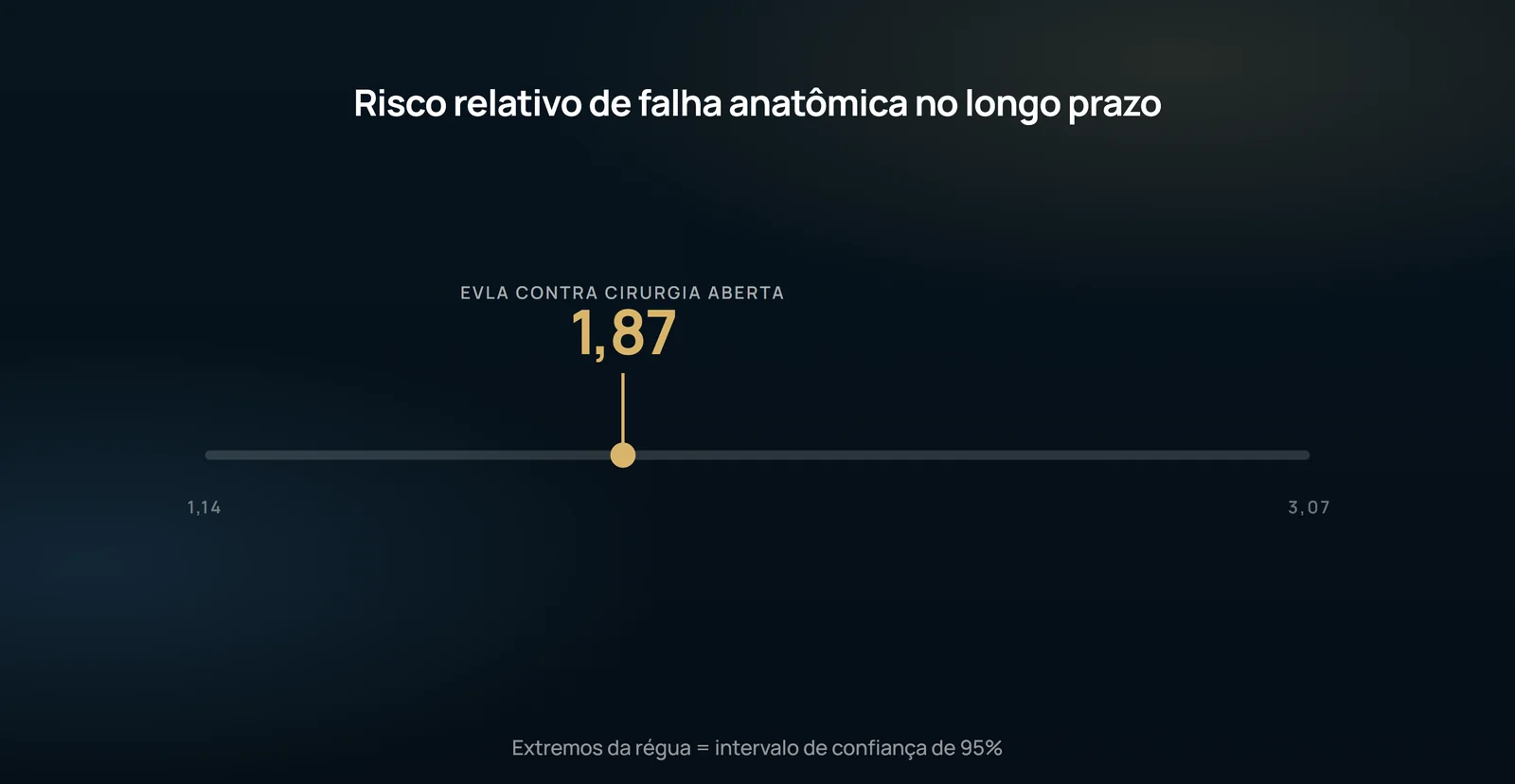
Network meta-analysis replicated the finding, with RR 1.90 (1.08 to 3.34). The authors record that this result contravenes a previous meta-analysis and supports another one, by Kheirelseid et al., who found RR 2.28 (1.20 to 4.30) for recanalization of the great saphenous after EVLA.
What about the patient? No difference
Clinical recurrence at end of follow-up: RR 0.91 (0.70 to 1.17), with 217 of 937 versus 224 of 787. Reintervention: RR 0.92 (0.72 to 1.18), with 99 of 784 versus 108 of 781. VCSS and AVVQ did not differ in early, medium or long follow-up. In another way: the outcome that the surgeon measures in the duplex separated the groups; the outcomes that the patient lives, no.
Both arms fail by different mechanisms, and this appears in the substitute outcomes. Neovascularization was consistently lower after EVLA — RR 0.06 early (NNT 16), 0.03 mid-term (NNT 9) and 0.38 long-term (NNT 11). The reflux of the anterior accessory saphenous vein followed the opposite path, with RR 3.62 (2.31 to 5.67) and NNH 15, from 77 out of 674 to 19 out of 651.
Who did worse, and who leads the ranking
Ultrasound-guided foam sclerotherapy had significantly greater anatomical failure than open surgery in early follow-up (RR 2.47; NNH 6), medium (RR 2.14; NNH 6) and long (RR 3.06; NNH 4), besides further reintervention (RR 1.79; NNH 2). Mechanochemical ablation was behind early radiofrequency (RR 2.77; NNH 12). Cyanoacrylate was the first placed in the SUCRA for lower anatomical failure in the early and long term, with RR 0.56 (0.34 to 0.93) against endothermic ablation at early, and also led the ranking of lower postoperative pain.
The complication profile continues to favor the intravenous: against open surgery, EVLA had less wound infection (RR 0.41), less hematoma (RR 0.55) and less paresthesia (RR 0.64). Venous thromboembolism did not differ in any comparison. Paresthesia was also lower in non-thermal and non-tumescent techniques against endothermic ablation (RR 0.35).
What this study does not allow to affirm
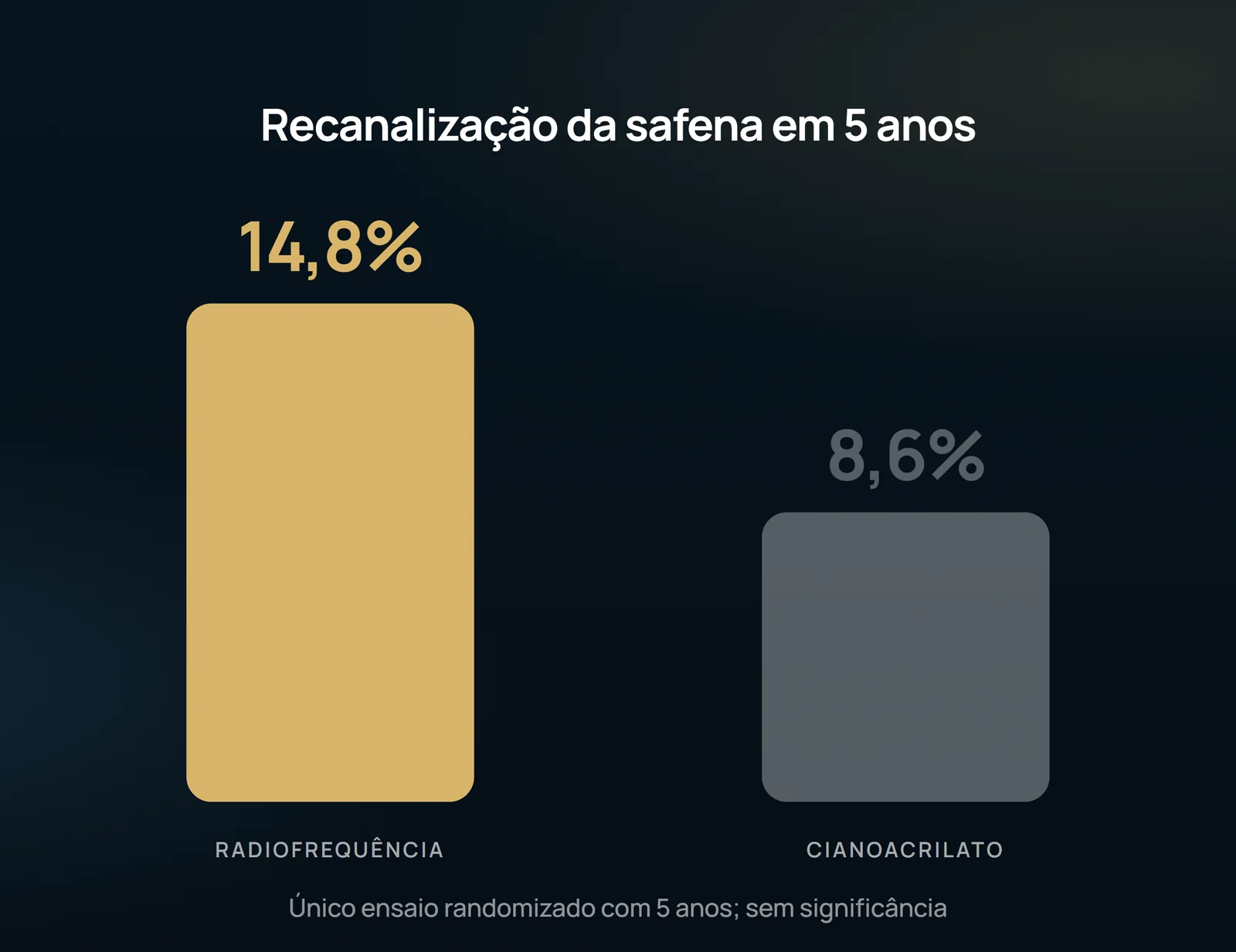
Blinding was the domain with the highest risk of bias: 85% of the trials did not blind the team and 75% did not blind those who evaluated the outcome; approximately 30% had unclear or high-risk randomization. The most common reason for lowering the quality of evidence was inaccuracy by insufficient sample. It had not been given long-term for radiofrequency, and the quality of life outcomes were not available for cyanoacrylate or mechanochemistry — so that the leadership of cyanoacrylate in the ranking is based on a narrow basis, as shown by the only 5-year trial, in which recanalization was 8.6% with cyanoacrylate against 14.8% with radiofrequency, without significance. Symptomatic improvement and cost were not analyzed. Nothing here authorizes promising results to a concrete patient: what the review offers is the rule to choose which outcome is being prioritized.

Content addressed exclusively to health professionals. No individual result is guaranteed: the indication depends on clinical evaluation and imaging examination of each patient (CFM 2,336/2023).