The vein surgeons once feared operating on — and what laser changed
The proximity of the sural nerve made the small saphenous vein the vein that was avoided operating. A Brazilian study followed 54 legs treated with endolaser and local anesthesia — and the figures explain the change of conduct.
 View the video lesson
The parva saphena runs on the back of the leg and accounts for about 15% of cases of reflux in limbs with varicose veins. It is not a marginal vein — but for decades it was the least operated on. The reason has its own name: the sural nerve.
The anatomical problem
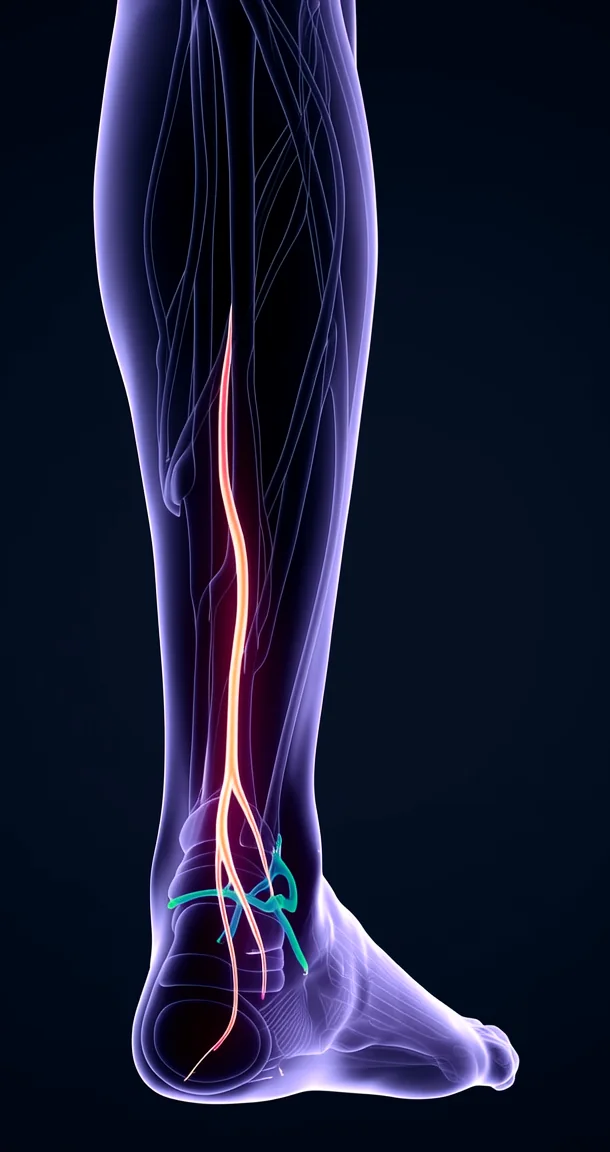
In conventional saphenectomy, dissection and removal of the trunk expose the nerve to traction and indirect thermal injury. The clinical result is paraesthesia in an area of the leg and foot — a complaint that persists after the vein has been resolved.
What the Brazilian study measured
Souza et al. followed 54 legs of 46 patients submitted to thermoablation with small saphenous vein endolaser, on an outpatient basis, with local and tumescent anesthesia — without general anesthesia, without blockage, without hospitalization. The 600 μm fiber was positioned 2.5 cm from the sapheno-popliteal junction, with 6 W power and continuous traction, all guided by ultrasound.
The venous clinical severity score dropped from 8.02 to 6.11, with statistical significance, and the diameter of the treated trunk decreased from 6.37 mm to 5.15 mm. All were discharged on the same day, about two hours later, with elastic stockings for 48 hours and stimulated walking from day one. Eleven out of 46 needed painkillers in the first five days.
Tumescence is the point of the technique
Perivenous tumescent anesthesia does three things at the same time: anesthesia of the path, dispels the trunk of the nerve and skin and dissipates the heat of the shot. It is more than the wavelength that separates the complication profile of the endolaser from the profile of open surgery.

Direct comparison with conventional surgery
The randomized trial by Samuel et al. allocated 106 patients with unilateral reflux of the small saphenous vein in two groups of 53, with follow-up of 1, 6, 12 and 52 weeks. Endolaser abolished reflux in 96.2% of the cases, against 71.7% of the conventional technique. Paresthesia occurred in 7.5% of the laser group, compared with 26.4% in open surgery.
What the study does not authorize to state
None of the patients had deep vein thrombosis. Still, five remained with paresthesia area on the 30th day and three developed phlebitis of the treated segment. And the follow-up was 30 days, in a single center, with 46 patients: it is consistent evidence of safety and early occlusion, not of long-term durability. Late recanalization and recurrence by neovascularization only appear in series with greater follow-up.
Content addressed exclusively to health professionals. No individual result is guaranteed: the indication depends on clinical evaluation and imaging examination of each patient (CFM 2,336/2023).