Laser performed worse for pain and satisfaction — yet still has a role
In the intrapatient study of Munia and collaborators, sclerotherapy comes forward in cost and pain. The conclusion, however, maintains three nominal indications for laser — and explains why the pain measured says more about protocol than technology.
 View the video lesson
When a trial concludes that the cheapest method also hurts less and lightens faster, easy reading is to retire the competitor. That's not what the authors do. The completion of the work keeps the Nd:YAG laser indicated in three named situations — and it is worth understanding why.
Two mechanisms that do not compete for the same space
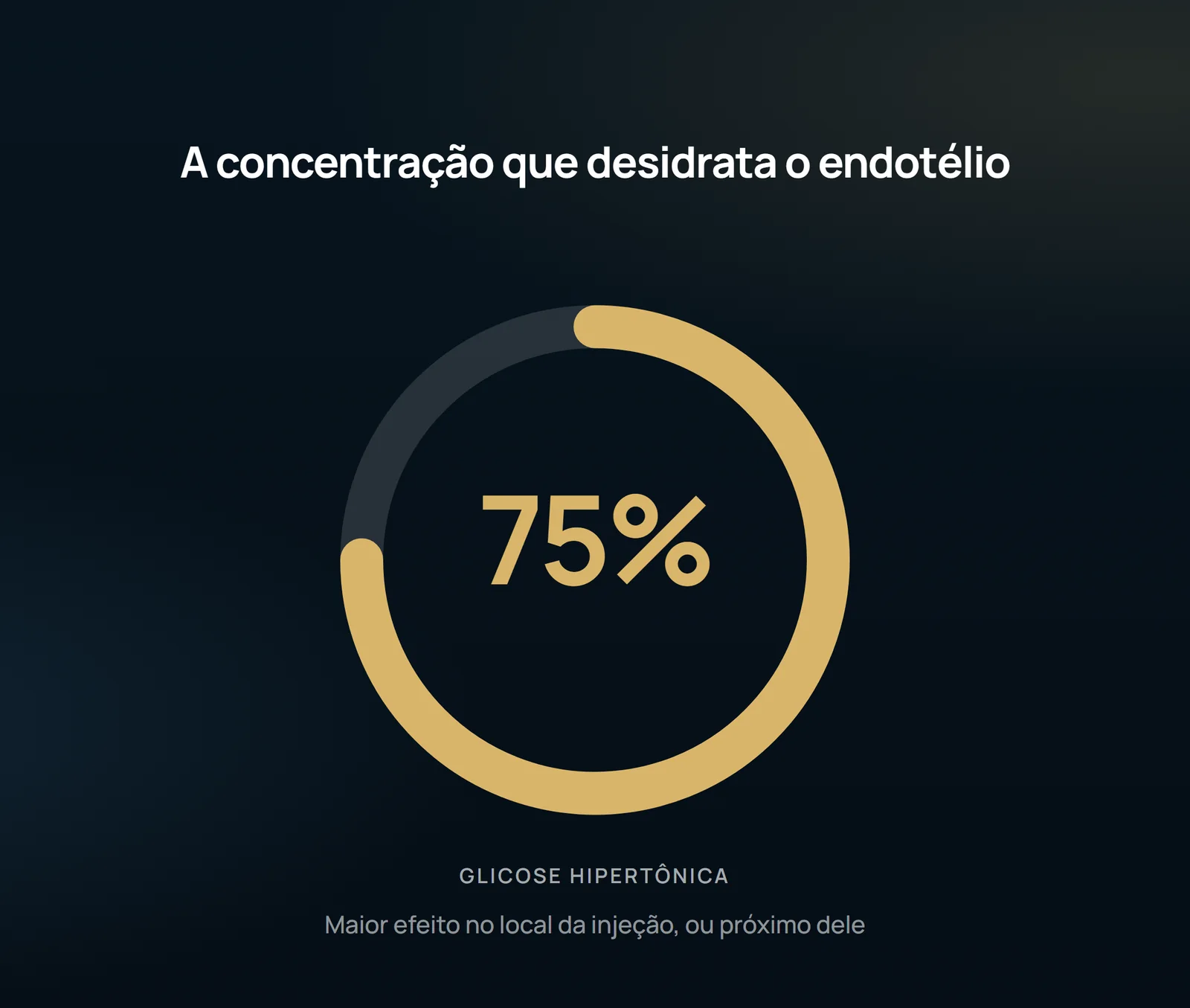
Sclerotherapy with hypertonic glucose at 75% acts due to osmotic dehydration of the endothelial cell. As dilution occurs with blood and intravascular serum, the solution has its greatest effect at or near the injection site: it is a short-range method that is entirely dependent on access to the vessel. The Nd:YAG laser acts by selective photothermolysis — principle described by Anderson and Parrish in 1983 — with energy density above 150 J/cm2 and long exposure times, without depending on puncture.
The three indications that the conclusion appoints
The three have the same logic: they are scenarios in which the injection is either contraindicated or is precisely the cause of the problem to be addressed. None of them depends on the laser being superior in clearance — they depend on the other way being closed.
The pain measured describes the protocol, not the technology
The authors are explicit: in this study, no skin cooling devices were used besides the laser cooling system, and therefore patients reported more pain. They add that when intense cooling methods are effective, they can significantly reduce pain, make treatment more tolerable and even improve epidermal protection. They also report having noticed less pain and greater tolerability when using smaller spots, despite the high energies, and mention Levy and Coles, who obtained similar results with spots described as painless, 2.5 mm, and a pulse of 10 ms, without topical anesthetic cream. Their working hypothesis is that pulses from 20 to 30 ms heat the epidermis more slowly, protecting it from burning.

Two findings that saw conduct
First, there was a single scar in the entire study, in a laser treated site, without compromising the final aesthetic appearance — and the authors attribute the case to the previous sun exposure of the patient and to the consequent increased energy absorption by melanin. This is selection and scheduling criteria, not chance. Second: the hyperpigmentation of larger vessels appeared with both methods, and the authors wrote that it could have been prevented by surgical removal of feeding collateral varicose veins before treatment.
The contrary literature that the article itself cites
In 2002, Lupton and colleagues compared laser with tetradecyl sodium sulfate sclerotherapy in a group of 20 patients and found better results with sclerotherapy after two sessions; in the same year, Coles and colleagues presented similar results with Sotradecol. The text also leaves a training alert: sclerotherapy is low cost, but requires adequate training to produce good results, and therefore inexperienced doctors can find lasers easier to operate and choose them for this reason. Choosing the device for lack of training is not an indication.
What the study does not authorize to state
The applicator physician evaluated the photographs along with the two independent observers — only these two were blinded as to treatment. Standardized photographic reassessment was performed one week after treatment, which does not measure durability, recanalization or recurrence. Only patients with isolated telangiectasis, class C1, without signs of chronic venous insufficiency, with a single device and a single applicator for both modalities were included. And, above all: post-sclerotherapy matting, needle phobia and sclerosing allergy were not outcomes measured in this trial — they are the authors' recommendation, not the result of the experiment. None of this allows promising results: the choice between the two methods is an indication decision, made in individual evaluation with a vascular surgeon.
Content addressed exclusively to health professionals. No individual result is guaranteed: the indication depends on clinical evaluation and imaging examination of each patient (CFM 2,336/2023).