Lipedema stages: what changes in management from stage 1 to 3 — and what half-stages add
A series of 102 women staged by a single examiner shows what goes up from one stage to another — pain, leg water, fat on the patella and ankle, risk of lymphedema — and what does not go up straight, such as BMI. For the vascular: where to palpate, what to look for in stage 3 and what the study does not authorize to conclude.
 View the video lesson
The study had 102 women with lipedema on five steps — 1, 1,5, 2, 2.5 and 3 — attended by a single physician in a single clinic over 6 months of 2024. The ruler is clinical: smooth skin with increased subcutaneous fat in stage 1; irregular skin with undulations in stage 2; lobes and folds of skin, especially in hip and knee, in stage 3. The half-stages entered because the patient is often between two steps: half of the wavy leg, or the whole wavy thigh without lobe. The distribution of the sample is uneven — 8 patients in stage 1, 35 at 1.5, 32 at 2, 8 at 2.5 and 19 at 3 — and this weighs on everything that follows.

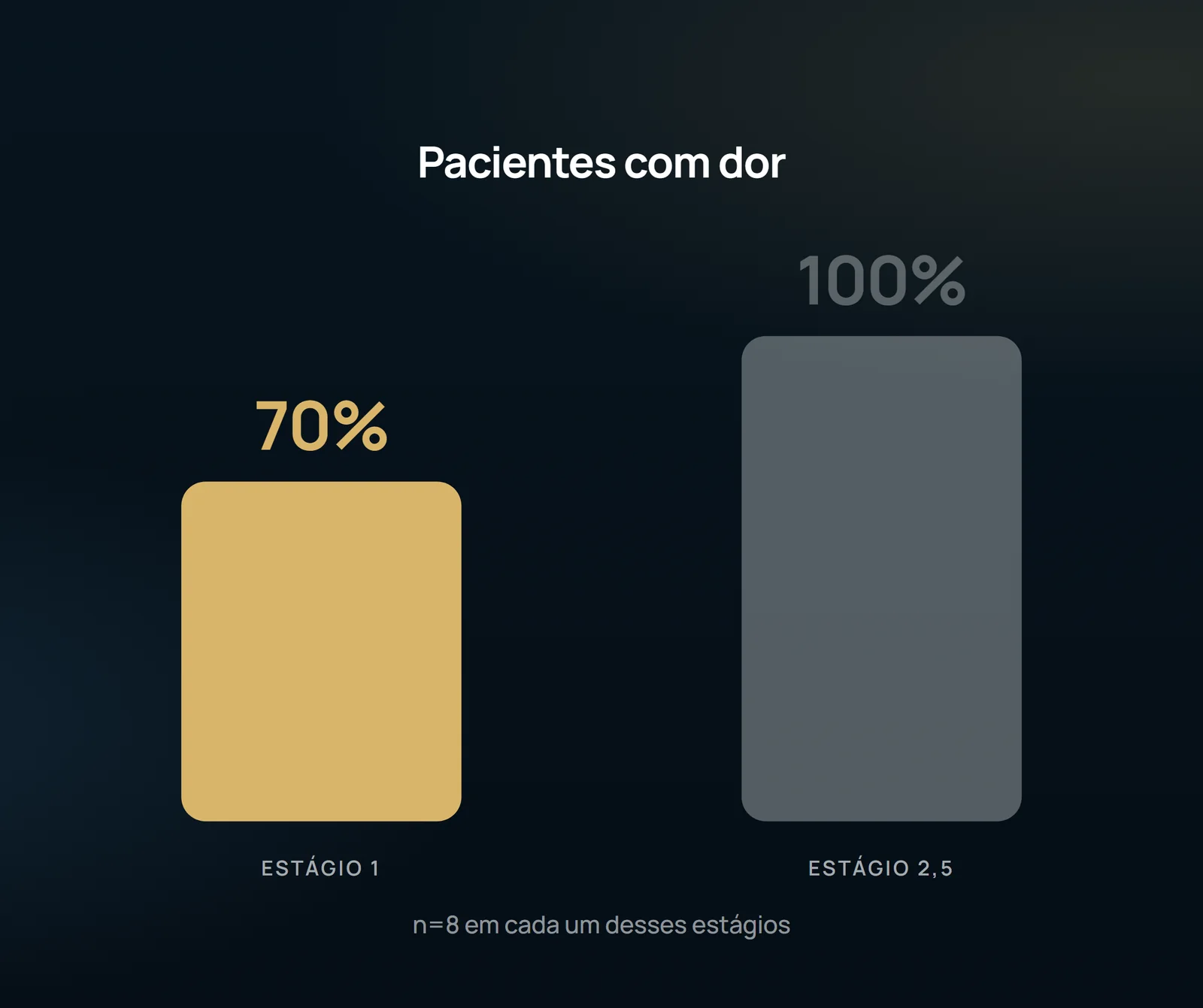
Pain: rises with stage, but 30% of stage 1 does not hurt
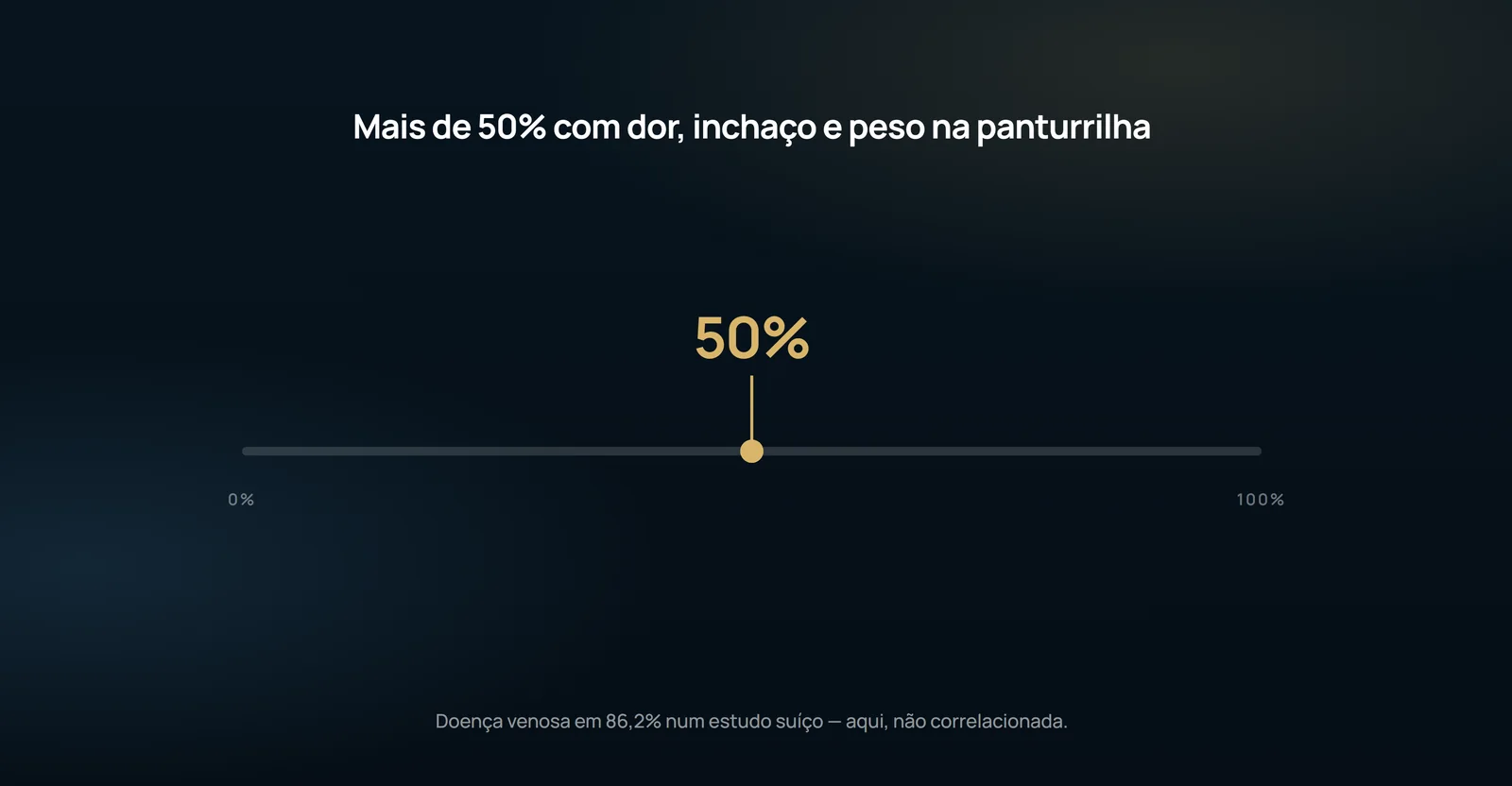
The calf was the most affected region, with more than 50% of patients reporting pain, swelling and weight sensation there. The authors cite a Swiss study with 86.2% of chronic venous disease in patients with lipedema, but report that this correlation was not made in their series. For the vascular surgeon, calf complaint is expected in lipedema — the vein is not automatically the cause. Systemic symptoms complete the condition: fatigue in 87%, mental fog in 76%, joint hypermobility by Beighton score in 75% at stage 1, 85% at stage 2 and 67% at stage 3 (fall that the authors attribute to age), and skin hypothermia at thermography, more frequent in stages 1.5, 2 and 3 than in stage 1 — qualitative evaluation, without number.
Fat per region: early cinnamon, late ankle
Fat on the tibia is high in all stages — the authors call it an early and definitive sign. The fat on the patella increases 40% from stage 2 to stage 3. In the forefoot, 50% more patients have stage 3 fat than in 1. The fat on the malleolus and around the Achilles tendon is a late finding in stage 3. In practice: fat cinnamon with thin ankle is initial disease; fatty cinnamon and ankle is advanced disease. It's palpation staging.
Water and muscle: what bioimpedance shows and what overestimates
The total body water in the four limbs rises with the stage, but separating per limb only the legs rise, on both sides; the arms do not change. The L-Dex index, used to track lymphedema, was significantly higher in stage 3 than in all others, in both legs — which puts the advanced patient at risk for lipolymphedema, and her examination needs to include foot, pitting, and Stemmer. The fluid was smaller in the left leg at all stages, and the authors speculate subclinical iliac compression (May-Thurner); it is speculation, not measured. The estimated muscle mass rises along with the fat in stage 3, but the authors warn that bioimpedance can overestimate muscle by water, intermuscular fat, edema and fibrosis. In the stand-and-walk test, stage 2 women had time similar to that of women aged 80 to 84 years.
BMI: rises, but is not the ruler

The mean age rises from 44.1 years in stage 1 to 59.1 in stage 3: the stage is also time of disease. However, the table presents a detail that the critical reader gives before quoting: stages 1 and 2.5, both with 8 patients, appear at the same age mean and standard deviation, 44.1 ± 3.9. Coincidence is possible in two small groups — but it is there.
What the study does not authorize to state
First, the design: a single examiner, in a single clinic, spent the entire series, and reproducibility among observers — declared by the article itself as objective, so that other doctors stay in the same way — was not tested. Two stages have 8 patients each. It is cross-sectional, with no control group without lipedema, and no treatment was compared; pain, fatigue and mental fog are self-reported. Therefore, the study does not authorize to say that the half-stage changes the treatment (he describes, does not test); does not authorize to use the stage as an indication of surgery (no conduct was compared); does not authorize to sell bioimpedance as a diagnosis of lipedema (she measured water and muscle, and the authors themselves say it overestimates); and does not authorize to promise to treat the calf vein takes away pain (the correlation with venous disease was not made). What goes for the office is what you read with your hand: early cinnamon, late ankle, foot and L-Dex in stage 3, absent pain not excluding stage 1, and mobility as the criterion that decides the next conversation. Compromise yes, guarantee never.
Content addressed exclusively to health professionals. No individual result is guaranteed: the indication depends on clinical evaluation and imaging examination of each patient (CFM 2,336/2023).