Varicose veins after saphenous laser ablation: the second step in tributaries
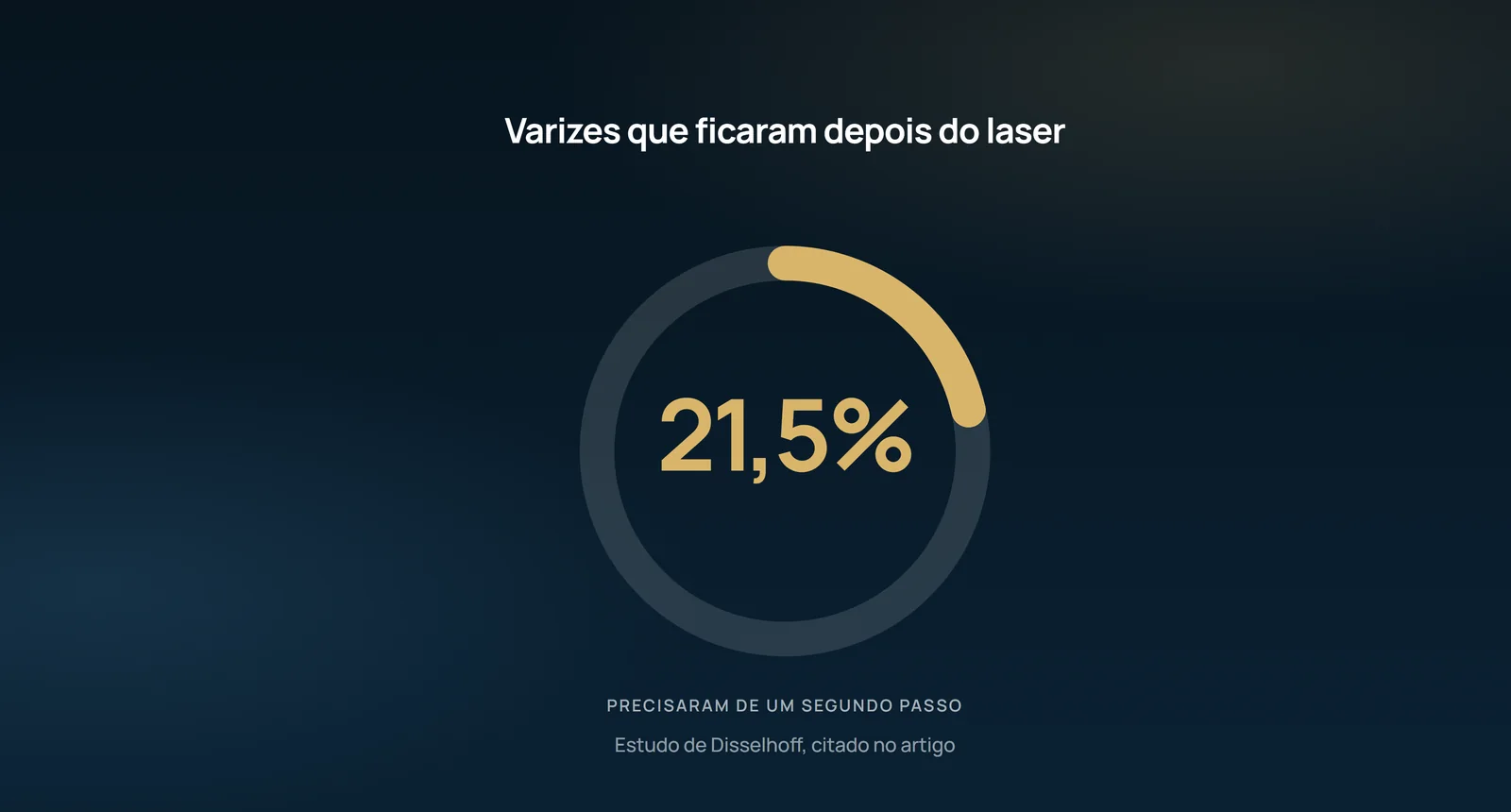
The ablation of the saphenous trunk does not directly treat branch varicosities. In the Disselhoff series, cited by Park et al., 21.5% of the limbs had persistent varicosity of accessory and needed additional treatment.
 View the video lesson
The endolaser occludes the incompetent saphenous trunk, but does not directly treat branch varicosities. That is why some of the patients still see varicose veins weeks after a technically well - done procedure — so outpatient phlebectomy or follow-up sclerotherapy are usually scheduled about 4 to 6 weeks later.
How much this happens
In the discussion of the article, Park et al. cited Disselhoff: despite the anatomical and functional success of the endolaser, 20 limbs (21.5%) had persistent varicosity of the accessory vein and needed additional treatment — compressive sclerotherapy in 16.7% and phlebectomy in 5.6%.
The two options and their cost
Sclerotherapy, including foam, has the disadvantages of pigmentation and the need for multiple punctures and sessions. Ambulatory phlebectomy, performed under local anesthesia, removes varicose veins of different sizes by microincisions, but is associated with bubbles, transient pigmentation, edema, telangiectasic matting and localized superficial phlebitis.
And the direct laser in the branch
The authors tested precisely this alternative, with a fiber of 400 μm in the branch, and concluded that it does not replace phlebectomy or sclerotherapy, the high failure rate and the risk of burning. After the procedure, they all used class II thigh stockings (30 to 40 mmHg) for at least 1 month, except for sleeping and bathing, with immediate walking.
What can't be said
The number of 21.5% comes from another series, cited in the discussion, and not from the Park essay itself, which is small, from a center and with short follow-up. There is no way to predict, for an individual patient, whether there will be a need for complementation.
Content addressed exclusively to health professionals. No individual result is guaranteed: the indication depends on clinical evaluation and imaging examination of each patient (CFM 2,336/2023).