A window of seconds: when a second pass still closes the vessel — and when it only adds heat
The vessels bluished instead of disappearing. The study by Parlette et al. describes what happens in the five minutes, in the fifteen minutes and in the next 21 days — and when a second step still contracts the vessel.
 View the video lesson
The most frequent decision of the leg transdermal laser is not the choice of the parameter — it is what to do after shooting, when the vessel does not disappear and turns blue. The work of Parlette and collaborators describes this sequence in rare detail, and it is from this description that a conduct comes out.
Stenosis and thrombosis don't end the same.
The immediate response of the vessel to Nd:YAG has two patterns: contraction of light, with hyalinization of the endothelium and perivascular collagen, or coagulation of intraluminal blood, which manifests as persistent bluishing. The histology of the study documented both scenarios. The authors are explicit: stenosis is preferable to thrombosis, because mechanically it produces fewer adverse effects.
The first five minutes
In vessels from 0.1 to 0.6 mm, treated with a 3 mm spot, immediate stenosis occurred with fluence of 280 to 320 J/cm2. In the next five minutes, most remained completely stenosed; a minority contracted and reappeared as an intraluminal blue wire.
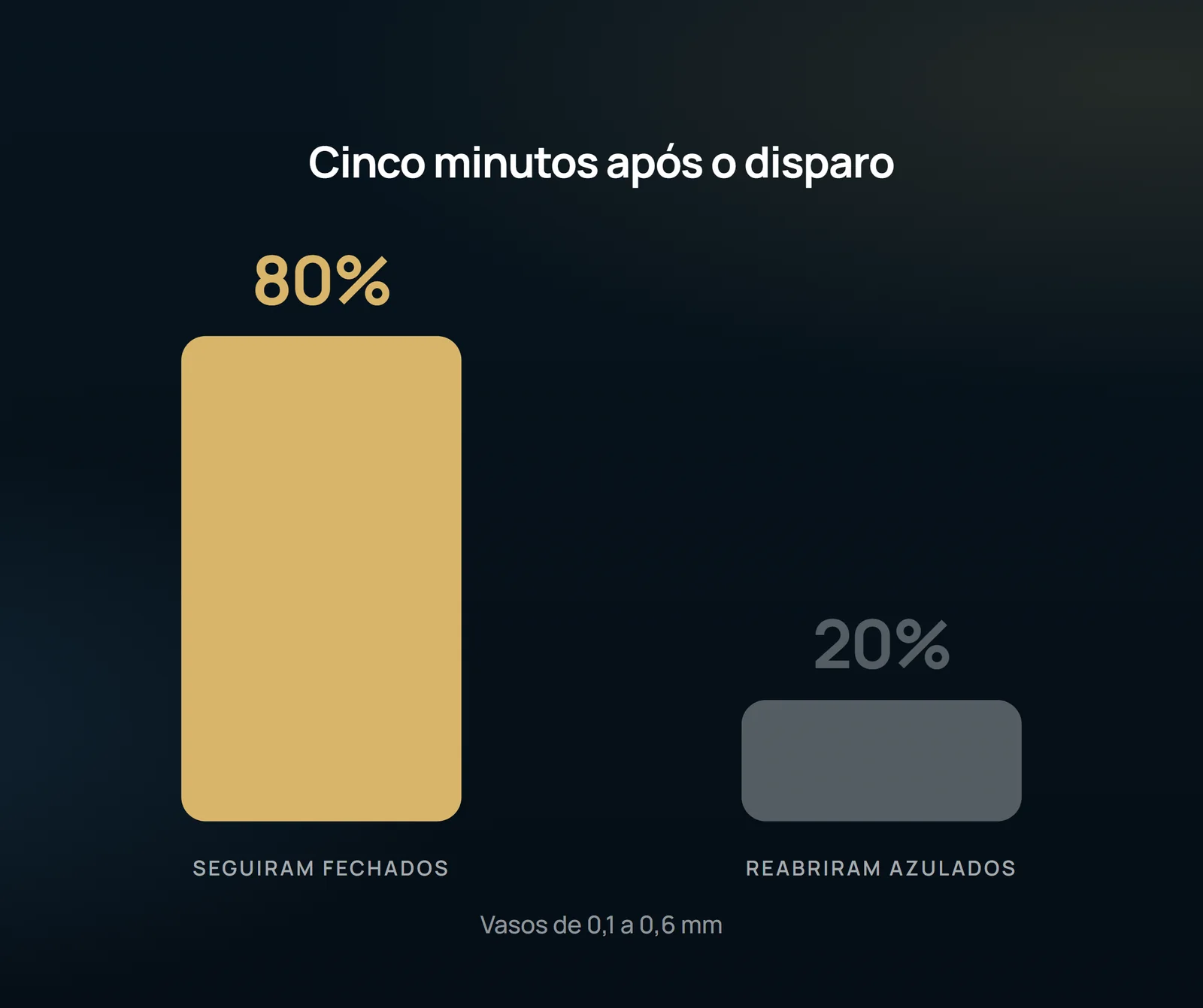
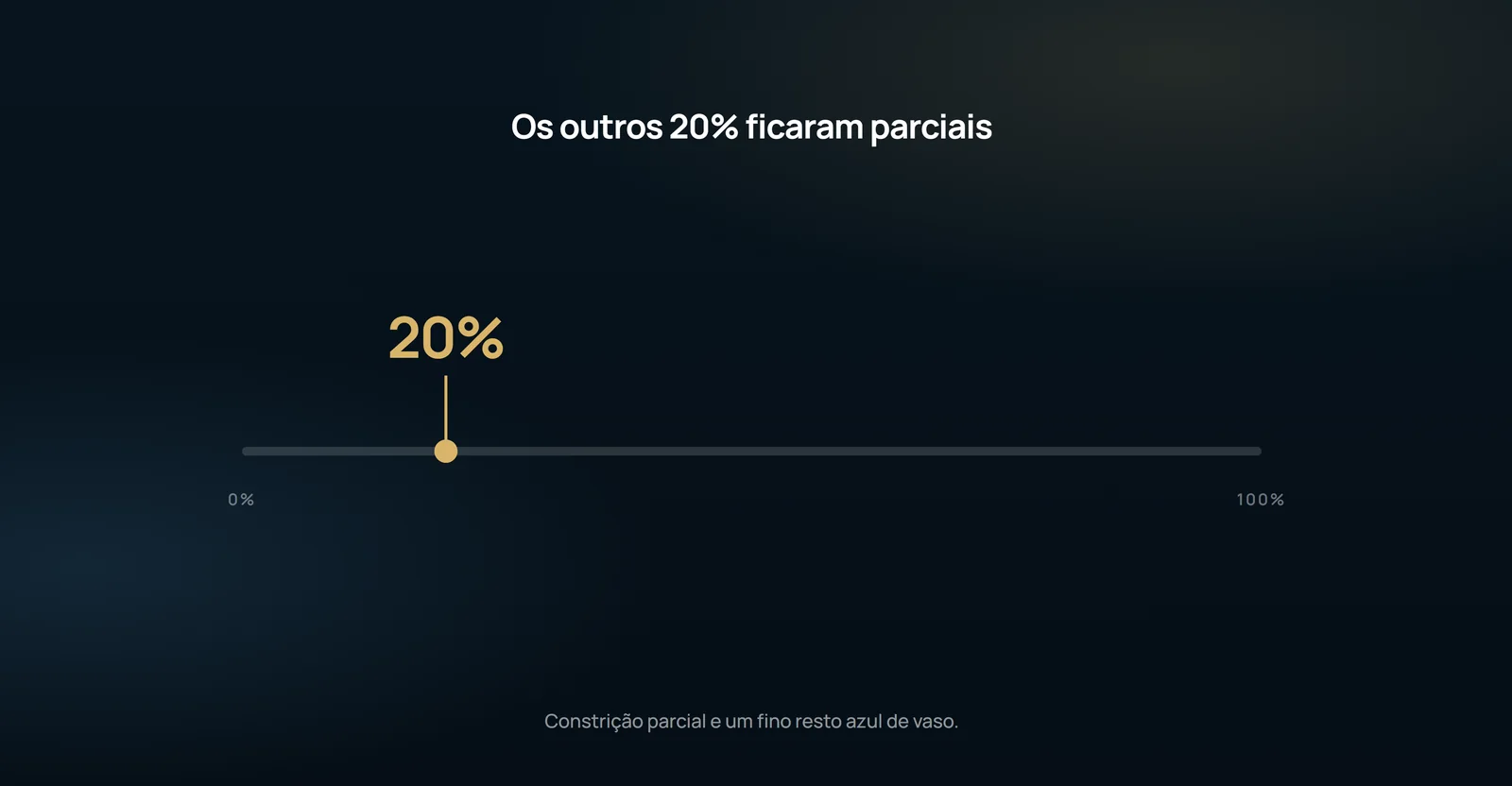
In vessels from 0.6 to 1.6 mm, the range of 200 to 260 J/cm2 produced constriction; with the highest fluence of this range, 80% of the vessels were completely stenosed. The remaining 20%, and all those treated with lower fluence, had partial constriction and a fine blue remnant — compatible with incomplete stenosis or complete stenosis followed by partial recanalization and early thrombosis.
The window of the second pass
This is where the duct is. The authors note that a bluish vessel, portrayed within a few seconds with a second stride, could be completely contracted — and that in the vessels of larger caliber with partial constriction, a second pulse resulted in closure. But once the solid thrombus was formed, which typically occurred about 15 minutes after irradiation, additional passes would no longer contract the vessel.
The signs that you've gone past the point
In about 20% of the vessels with incomplete immediate stenosis — usually larger ones — the blue thread evolved to a firm cord larger than the original vessel diameter, with erythema and severe edema. At 21 days, thrombi persisted in some vessels above 1 mm and were drained with 18 G needle; around them appeared early linear hyperpigmentation, more intense when there was evident rupture of the vessel. Accidental stacking of wrists, in one case, produced spot size bubble and a hypopigmented scar.
The immediate response predicts the outcome
The authors' synthesis is economic: the outcomes corresponded to the initial responses. Where there was permanent stenosis that lasted beyond the first day, the vessels remained clean. Where the light was only partially stenosed, the clearance was partial. Where there was partial stenosis with thrombosis, there was eventual clearance, but with a higher risk of hyperpigmentation. In the complete treatment session, the three blinded observers evaluated complete clearance in 71% of the treated vessels.
What the study does not authorize to state
The window of the second step is a clinical description of the authors, not an outcome tested: there was no comparator arm, draw or blinding for this decision, and the statistical analysis of the study covered purpura, edema and immediate stenosis — not the conduct of passing on. The sample consisted only of women, with phototypes from I to IV and exclusion of V and VI, without concomitant venous stasis and without the use of compression stockings. The clearance was measured after a single treatment session, with a final evaluation in 16 weeks, in a single center. None of this allows promising results to a patient: what is taken from here is a criterion for reading the immediate response, to be applied by a doctor in the individual evaluation.
Content addressed exclusively to health professionals. No individual result is guaranteed: the indication depends on clinical evaluation and imaging examination of each patient (CFM 2,336/2023).